Ignition by electrical discharges
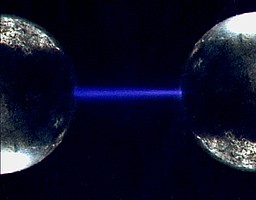
Project 5 is focused on the experimental examination of ignition by electrical discharges with respect to safety assessment in hazardous areas. In the first period, two important types of electrical discharges – non-equilibrium plasmas due to streamer discharges and thermal plasmas – shall be examined.
The energy of an examined electrical discharge is always near the minimum ignition energy. Using optical emission spectroscopy, detailed information about the temporal evolution of atomic oxygen and rotational and vibrational temperatures of molecular nitrogen can be yielded. Time and spatially resolved laser-induced fluorescence measurements of OH radicals will be performed yielding four subsequent images during one single ignition event. Hence, detailed information about flame kernel growth and flame velocities can be derived. In the case of ignition by non-equilibrium plasmas detailed examination of atomic oxygen using two-photon absorption laser-induced fluorescence will be used to examine the temporal evolution of this radical in the ignition volume. All these experiments are necessary a) in the case of thermal plasmas to determine the thermal losses towards the electrodes and b) in the case of non-equilibrium plasmas to develop a kinetic scheme of the chemical processes by streamer discharges.
Along with numerical simulations of these processes useful information about the ignition process induced by electrical discharges will be yielded.
Scientists
| Project leader |  Dr.-Ing. Detlev Markus Dr.-Ing. Detlev Markus |
| Researcher |  Stefan Essmann Stefan Essmann |
Publication single view
Title: |
Ignition of hydrogen/air mixtures through electric discharges at high frequency AC voltage |
|---|---|
| Author(s): | , , and |
| Journal: | Chem. Eng. Technol. |
| Year: | 2009 |
| Volume: | 32 |
| Pages: | 288-291 |
| DOI: | 10.1002/ceat.200800528 |