Ignition by hot free jet flow
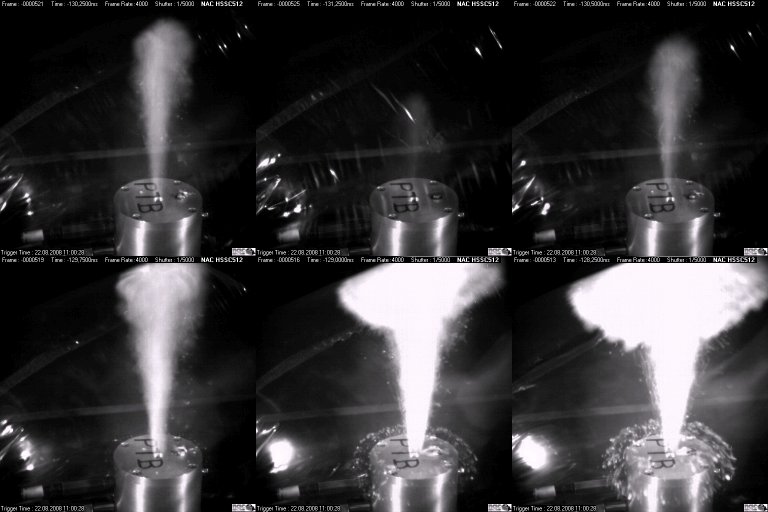
In project 7, ignition caused by turbulent free jets of hot gas impinging into a fuel/air mixture is investigated. This is done by numerical simulations using a statistical approach to treat turbulence and turbulence/chemistry interactions, and by experiments which are used to create empirical data which help to assess the accuracy of the numerical simulations. During the project, the numerical models underlying the simulations will be continuously refined, so that finally an improved simulation tool with higher predictive capabilities than currently possible will result. In this process, there will also better insight into the detailed processes in hot jet ignition be gained.
In detail, a probability density function (PDF) method will be used for treating the turbulent jet and its interaction with the surrounding fuel/air mixture. A full transport equation for the joint PDF of velocity and scalars will be solved. To describe chemical reactions, already existing reduced models will be used.
Measurements in free jets mixing with quiescent surrounding air will be performed using laser-based techniques. To isolate effects of missing and of reaction, two kinds of experiments will be performed, namely inert mixing of a low-density jet (helium) with nitrogen, as well as a reacting configuration with a hot jet of combustion products impinging into a fuel/air mixture.
The model development will profit from the input of project 1 (Physical and chemical models for ignition processes) and project 6 (DNS).
Scientists
| Project leader |  Dr.-Ing. Robert Schießl Dr.-Ing. Robert Schießl |
| Co-applicant | Dr.-Ing. Detlev Markus |
| PhD student | Franziska Seitz |
Publication single view
Title: |
2D Mixture Fraction Studies in a Hot-Jet Ignition Configuration Using NO-LIF and Correlation Analysis |
|---|---|
| Author(s): | , , and |
| Journal: | Flow Turbulence Combust. |
| Year: | 2011 |
| Volume: | 86 |
| Pages: | 45-62 |
| Publisher: | Springer Netherlands |
| DOI: | 10.1007/s10494-010-9285-0 |
| Abstract: | The problem of measuring mixture fraction (defined here as the fractional part of mass originating from the exhaust gas jet) during the mixing of an unsteady hot exhaust gas jet impinging into a quiescent premixed hydrogen/air mixture is addressed. The diagnostic method is based on planar Laser-Induced Fluorescence of nitric oxide (NO) that is seeded to the hot jet and used as a tag for mixture fraction. The research work presented in this paper focusses on the analytical and experimental data employed for the estimation of mixture fraction using NO as a tracer. Since the NO LIF-signal does not solely depend on the amount of NO, but also on temperature and overall chemical composition, additional information is normally required to transform LIF-signals into mixture fraction values. To provide this additional information, the concept of reduced state spaces is applied: Correlations between state variables (temperature and species) are exploited to establish relationships between the measured signal and the mixture fraction. Simple numerical model simulations are used in combination with spectroscopic calculations to check for correlations between NO-LIF signal and mixture fraction. The result is that sharp correlations between NO-LIF signals and mixture fraction exist, provided that chemical reactions have not yet significantly influenced the flow. These correlations display only little sensitivity with respect to changes of the jet temperature, amount of NO seeded to the jet, and jet velocity. Measurements of NO-LIF were then performed for a non-reacting case before ignition, and mixture fraction maps were obtained from the measured LIF-signals by exploiting the correlations. The resulting data reveal the different driving forces behind mixing at regions near to the jet tip and at the radial shear layers. |